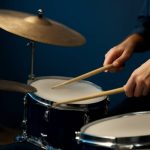
Stephen Flinn is an active composer, performer, and improviser based in Berlin, Germany, whose work stands at the incisive edge of sound, motion, and material. Performing throughout Europe, Japan, and the United States in formats ranging from intimate solo statements to expansive large-group dialogues, he shapes texture as deftly as he shapes time. His decades-long exploration of traditional percussion has yielded a personal vocabulary of distinct sounds and phonic textures, developed through relentless practice and the pursuit of new extended techniques suited to diverse musical settings.
At the heart of this body of work is a sensitivity to resonance: how a drumhead sighs, how metal shimmers under pressure, how silence frames a gesture. It is a practice grounded in listening and in the delicate mechanics of cause and effect. The results cross boundaries frequently described by terms like Experimental Percussion and Avant Garde Percussion, yet they are neither style nor trend. They are the outcomes of attention, patience, and the curiosity to discover what a material reveals when handled from multiple angles—rubbed, scraped, muted, bowed, or coaxed to speak in overtones barely heard but deeply felt.
Inside the Instrument: Materials, Motion, and the Vocabulary of Experimental Percussion
What distinguishes an Experimental Percussion practice is not only the choice of instruments, but the approach to touch, weight, and the choreography of the hands. Traditional drums, cymbals, and small percussion become portals for new language when contacted in non-traditional ways: hands replacing sticks, sticks becoming levers, brushes serving as erasers to blur attack into warmth. A performer who invests years in these details learns to hear the microclimates of sound—skin tension, sympathetic vibrations, and the way a room amplifies or swallows a tone. This listening evolves into a vocabulary where each gesture is a consonant and each resonance a vowel; together they form sentences that can be punctuated, elongated, or intentionally left incomplete.
Extended techniques emerge as practical solutions to musical questions. How can a cymbal sustain without the glare of a hard strike? By bowing or by slow circles with a soft mallet, the metal’s harmonic series opens into a singing field. How can a drumhead produce pitch and grain simultaneously? With carefully placed pressure from the palm, the head can bend, groan, or whisper while the other hand articulates micro-attacks that granulate the sound. Found objects extend the palette not as novelties, but as pragmatic tools: the ceramic rasp of a broken tile, the glissando of a glass rim, the friction of leather against wood. None of this invalidates traditional technique; it refines it by reframing intent.
In this terrain, dynamics and silence are as tangible as wood and metal. Silence becomes the connective tissue that turns events into narratives. By withholding impact, the performer reveals contour; by staging density, the listener gains perspective on breath and decay. Choices of scale and density—the slow roll of thunder versus the dry patter of light rain—shape the arc of a piece more decisively than tempo markings. Through patient refinement, a lifelong laboratory emerges, where technique and concept meet in service of immediacy. Such an approach allows the modern percussionist to integrate seamlessly into contexts as varied as chamber improvisation, sound-based installation, and dance, while carrying a recognizable voice forged from attentive craft.
Improvisation with Bodies in Motion: Butoh, Ensemble Dynamics, and the Poetics of Timing
Improvisation is not merely “playing without preparation”; it is an ecology of decisions that organizes time, touch, and attention. In collaboration with Butoh dancers—where breath, gravity, and micro-movement guide the performance—the percussionist becomes a kinetic listener. Gestures on skin, metal, and wood answer the body’s arcs and hesitations, sometimes mirroring, sometimes counterpointing, and often carving a third path that makes the space itself audible. For Stephen Flinn, whose performances span Europe, Japan, and the United States in solo, duo, and larger ensembles, this interaction is not accompaniment but co-creation. The drum’s contour becomes a partner to the dancer’s spine; a cymbal swell anticipates a shift of balance; a rubbed gong amplifies a held gaze.
Within large-group settings, the vocabulary shifts again. Here, the challenge is clarity—how to project identity while supporting collective form. Extended techniques help distinguish voices without crowding them. A single bowed plate can thread between horns and strings; dry clicks across a drum rim map a pulse that is not a meter but a scaffold; granular rolls and air-like textures place timbral shadows behind or beneath other statements. This approach thrives on restraint and on the willingness to leave space, allowing the ensemble to “breathe” and encouraging emergent structures to surface. The result is music that rewards close listening: polyphonic textures where each line maintains its own gravity yet bends to a shared center.
Solo contexts sharpen the responsibility of form. Without external cues, the performer must create tension and release through contrast: dense brush swarms against muted drumhead murmurs, severe metallic strikes punctuated by velvet quiet, or a sudden pivot from friction to resonance. The pacing often aligns more with the body’s rhythms than with grid-based time—a physiological tempo learned from walking, inhalation, and the small reflexes of balance. This is where labels like Avant Garde Percussion become less a genre and more a lens: a way to describe how sound can unfold when the performer’s decisions emerge from deep listening to place, to materials, and to the other presences on stage.
For listeners and presenters seeking a tangible point of entry to this practice, the work of the Avant Garde Percussionist becomes an audible map. It shows how form can arise from timbre, how collaboration can be choreographic as well as sonic, and how the rules of interaction are drafted in real time. In this perspective, percussion is not an anchor of fixed time but a medium through which time itself can be stretched, folded, and made visible.
Case Studies in Sound: Site, Collaboration, and Recording as Research
Case studies bring abstractions into practical focus. Consider a site-specific solo performance under a vaulted hall. The performer surveys the room first: claps to test early reflections, gentle taps to locate nulls where the sound vanishes. The set begins with barely audible friction on a cymbal edge; the hall magnifies its harmonics, turning filament into fabric. A muted frame drum adds a low thrum that blooms as the player steps toward a resonant corner. By the time harder articulations arrive, the audience’s ears have reset to the space’s full dynamic range. Here, technique serves architecture; choices are shaped by how stone and air collaborate with metal and skin.
In a duo with a string player, spectral balance becomes paramount. Rather than competing for frequency, the percussionist builds a complementary band: filtered scrapes and breathy textures nestle beneath the string’s lyrical arc. If the string player sustains a high overtone, the percussionist may layer warmth through soft mallets on toms, tuned by hand pressure to hug the note’s lower partials. Sudden pivots—such as arresting texture with a palm mute—create negative space that lets the string line leap forward. The dialogue thrives on constraints: limited instruments, narrow dynamic bands, or time-boxed miniatures that force concise statements. Each limitation sharpens intent and delivers clarity to the listener.
Large ensemble improvisation benefits from modular thinking. A percussionist might develop a set of “scenes” rather than fixed pieces: friction scene, pulse scene, resonance scene, and silence scene. These can sequence or layer depending on what the ensemble offers in the moment. In the friction scene, brushes, rubber balls, and fingertips sketch grain without heavy attack, inviting winds and electronics to interlace. In the pulse scene, rim clicks and subtle hand drumming provide a scaffold that does not dominate but invites alignment. In the resonance scene, gongs and singing metals unfurl a harmonic field where pitches can emerge naturally. Silence scenes act as resets, giving the music permission to pivot. Such modularity encourages coherence without constraining spontaneity.
Recording, too, functions as research rather than mere documentation. Close microphones capture the micro-details of touch; room microphones preserve the performance’s spatial narrative. Playback becomes a laboratory: which gestures halo beautifully in air but collapse in close-mic detail? Which textures bloat on speakers but feel transparent in the room? Iteration across sessions refines decisions for the stage. The process also clarifies how extended techniques translate for different audiences—physical viewers in a hall versus headphone listeners attuned to intimate grain. By curating the signal chain to emphasize acoustic integrity, the performer keeps the focus on material truth: wood sounds like wood, skin like skin, metal like metal, each speaking in its native accent.
Across these contexts, the throughline remains tactile intelligence. The same drumhead can be a drone instrument, a rhythmic engine, or a hushed storyteller, depending on hand shape, pressure, and the willingness to wait for the sound to unfold. This is where the craft of a seasoned Experimental Percussionist resonates most clearly: not in the novelty of objects, but in the rigorous attention that transforms modest means into vivid speech. For a Berlin-based artist immersed in international collaboration—from Japan’s intimate theaters to Europe’s resonant cathedrals and the United States’ experimental spaces—the practice grows with each room and relationship. Technique and collaboration reinforce each other, ensuring that percussion remains a living language: precise, responsive, and endlessly capable of saying something new.